Courses
Catalysis, An Integrated Approach (CAIA)
Catalysis…
Catalysis contributes 20-30% of the gross domestic products of industrialized countries. Catalysts play a vital role in the production of transportation fuels, bulk and fine chemicals in a sustainable way. Many more improvements are expected for the next years.
… a fascinating discipline
NIOK, the Dutch school of research in catalysis, with some 200 PhD students involved in research, offers the opportunity to gain a deeper insight into various aspects of this fascinating discipline: fundamental, theoretical, homogeneous, heterogeneous, industrial catalysis and biocatalysis. The main theme of this course is the molecular approach of catalysis in view of its applications, from catalyst preparation and characterization to reactor engineering.
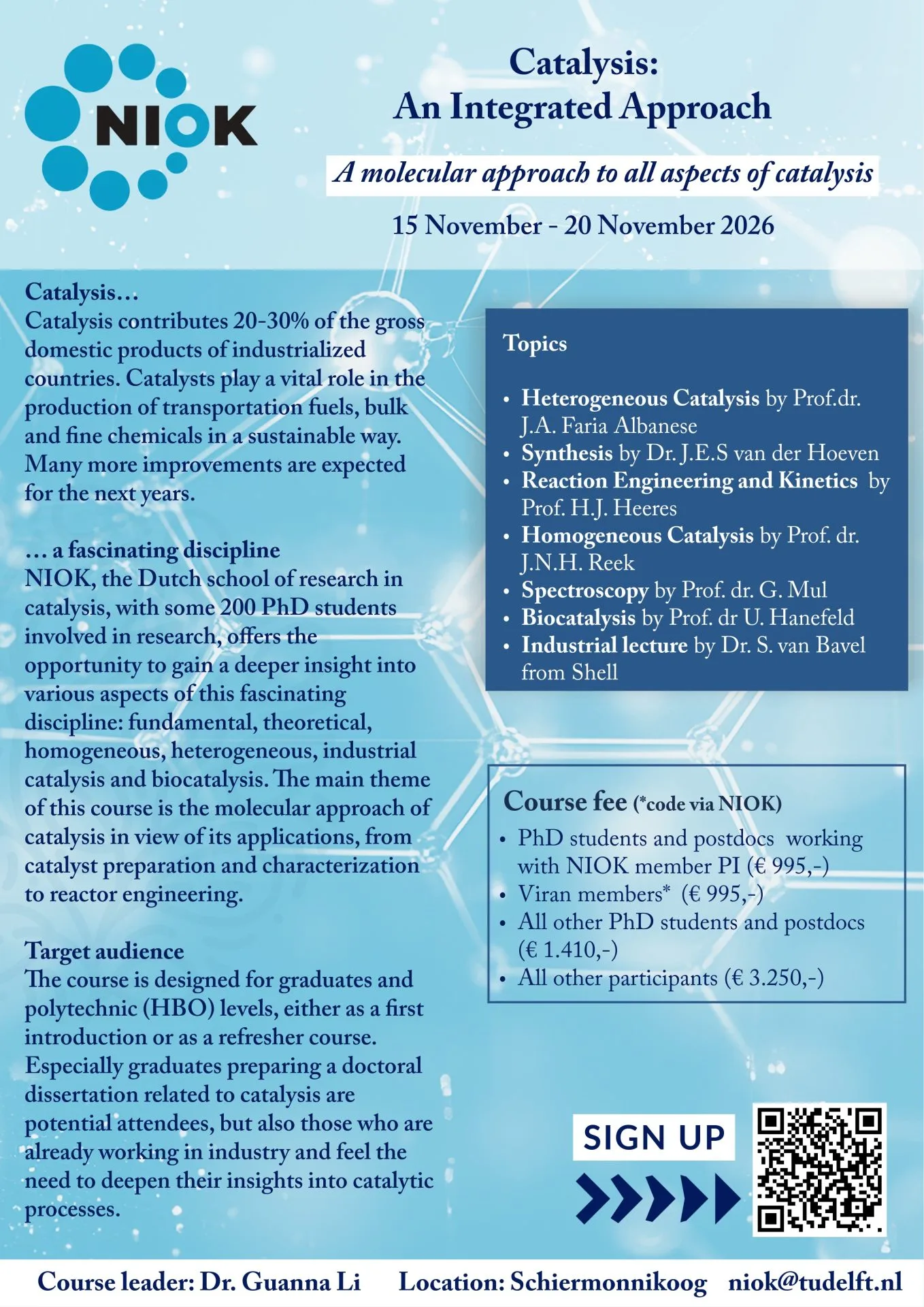
Date and location
Flyer CAIA 2026 check here.

Target audience
The course is designed for graduates and polytechnic (HBO) levels, either as a first introduction or as a refresher course. Especially graduates preparing a doctoral dissertation related to catalysis are potential attendants, but also those who are already working in industry and feel the need to deepen their insights into catalytic processes.
Registration
Registration is now closed. Please contact us at niok@tudelft.nl
CAIA course content
Introductory part
- history of catalysis: homogeneous, heterogeneous and biocatalysis
- chemical and technological aspects of a number of important industrial processes. These processes will also form the framework for the subjects to be treated in the fundamental and applied parts of the course.
- chemical kinetics of catalyzed reactions
Fundamental catalysis
- chemical bonding to surfaces, in metal complexes and in enzymes
- elementary reaction steps in catalysis
- kinetic and mechanistic processes of catalysis
Applied Catalysis
- catalytic reaction engineering
- preparation of catalyst supports including zeolites
- preparation of supported catalysts
Catalyst characterization
- laboratory and advanced methods, incl. in situ and operando methods
- spectroscopic techniques
- temperature programmed techniques
- adsorption methods
Modern developments seen from two angles
- from the process technology side: more efficient and cleaner processes
- from the theoretical side: development of fundamental catalysis towards an independent science within chemistry and physics.
Textbook
Hanefeld Catalysis – An Integrated Textbook for Students